Vendor Guides
Top Pokemon Card Vendor Tips: How to Build a Profitable Card Selling Business
Whether you're flipping cards from your living room or running a full-scale operation, these battle-tested strategies will help you stand out in a crowded market and build real, lasting revenue.
Quick Answer: Essential Pokemon Card Vendor Tips
Know Your Market: Track price trends daily using tools like TCGPlayer, eBay sold listings, and Double Holo's vendor intelligence suite (AI picks, market sentiment, price forecasting). The market moves fast—data-driven vendors win.
Authenticate Everything: One fake card ruins your reputation. Learn to spot fakes, invest in authentication tools, and when in doubt, don't list it.
Price Strategically: Underpricing leaves money on the table. Overpricing kills velocity. Use price forecasting tools to find the sweet spot.
Photograph Like a Pro: Quality photos sell cards. Use consistent lighting, clean backgrounds, and show every angle including flaws.
Choose the Right Platform: Platform fees vary widely. Double Holo charges just a 4.9% seller platform fee (plus card processing), compared to 10-13%+ on other marketplaces—plus built-in business intelligence tools for serious vendors.
The Pokemon TCG market has matured significantly since the pandemic boom. Gone are the days when you could buy anything at retail and flip it for double. Today's market rewards vendors who bring real expertise, operational excellence, and genuine passion for the hobby.
I've seen sellers go from listing a handful of cards on eBay to running six-figure annual operations. The difference between those who make it and those who burn out? Treating this like a real business from day one—and using data to make smarter decisions.
This guide covers everything we've learned from working with thousands of sellers—from solo flippers to established card shops. Let's get into it.
Double Holo Vendor Intelligence Suite
Most vendors rely on gut feelings and manual research. The best vendors use data. Double Holo's business intelligence tools give you an edge:
AI Picks & Analysis
Machine learning surfaces cards likely to appreciate based on historical patterns and demand signals.
Market Sentiment
Aggregate buyer and seller activity to understand whether the market is bullish or bearish on specific cards.
Price Forecasting
Predictive models help you time buys and sells based on projected price movements.
Grading ROI Calculator
Know exactly when grading is worth the cost—factoring in fees, turnaround time, and graded premiums.
Combined with a 4.9% seller platform fee—the lowest of any major marketplace—Double Holo is purpose-built for vendors who want to run their card business like a real business.
1. Know Your Market Inside and Out
The Pokemon card market isn't static. A card worth $200 last month might be $120 today—or $350. Successful vendors treat market research as a daily habit, not an occasional task.
Daily Market Research Routine
- Morning:Check overnight sales on your active listings. Note which cards moved and at what prices.
- Midday:Browse eBay sold listings and TCGPlayer recent sales for cards you're considering purchasing.
- Evening:Scan social media and Reddit for trending cards, upcoming releases, and market sentiment.
Price Research Tools Every Vendor Needs
Double Holo Vendor Intelligence
AI-powered price forecasting, market sentiment analysis, and grading ROI calculators. Purpose-built for Pokemon vendors who want data-driven decisions, not guesswork.
TCGPlayer Market Price
Real-time market prices based on actual sales. The baseline for raw card pricing.
eBay Sold Listings
Filter by "Sold Items" to see what cards actually sold for—not what people are asking.
130point.com
Historical eBay data going back years. Essential for understanding price trends.
PSA Price Guide
For graded cards, check the PSA Price Realized Database. Population reports matter too.
Pro Tip
Set up eBay saved searches with email alerts for cards you're actively buying. When a deal pops up, you'll know immediately. Speed matters when good inventory hits the market.
2. Sourcing Inventory the Smart Way
Your business lives and dies by your ability to source inventory at the right prices. The best vendors have multiple sourcing channels and know exactly what margins they need on each.
High-Margin Sourcing
- • Local collection buyouts (40-60% of market)
- • Estate sales and storage units
- • Facebook Marketplace bundles
- • Local card shop clearance
- • Card show vendor deals
Lower-Margin, Higher-Volume
- • TCGPlayer buylist arbitrage
- • eBay auction sniping
- • Distributor sealed product
- • Other vendor overstock
- • Japanese import singles
The Collection Buyout Formula
Collection buyouts are where serious vendors make their best margins. Here's the approach that works:
- 1Get detailed photos first. Ask for close-ups of the best cards before committing to an in-person meeting.
- 2Calculate quickly. Identify the top 20 cards by value. That's usually 80% of a collection's worth.
- 3Offer 50-60% of retail for quality collections. Go lower (40-50%) if condition is questionable or you're taking bulk.
- 4Bring cash. Sellers take cash deals seriously. It closes deals faster than "I'll PayPal you later."
Warning
Never buy a collection sight-unseen based on verbal descriptions. "Near Mint" means different things to different people. Always verify condition in person or with high-quality photos before committing.
3. Authentication: Protecting Your Reputation
Nothing destroys a vendor's reputation faster than selling a fake card. Even an accidental counterfeit sale can trigger negative reviews, platform bans, and chargebacks. Authentication isn't optional—it's foundational.
Authentication Checklist for Every Card
The Light Test
Hold the card up to a bright light. Authentic cards have a black layer in the middle that blocks light. Fakes often let light through or show inconsistent opacity.
The Bend Test (Carefully)
Real Pokemon cards spring back to shape with a gentle bend. Counterfeits often feel stiffer or more papery and may crease permanently.
The Loupe Test
Use a jeweler's loupe (10x magnification). Real cards show clean dot patterns in the printing. Fakes show blurry, smeared, or misaligned dots.
The Weight Test
Use a precision scale. English Pokemon cards weigh approximately 1.7-1.8 grams. Significant variance is a red flag.
Compare to Known Authentic
Keep a reference binder of cards you're 100% certain are real. Side-by-side comparison catches many fakes.
High-Risk Cards to Scrutinize
- • Base Set Charizard - The most counterfeited Pokemon card by far
- • 1st Edition stamps - Fake stamps are commonly added to unlimited cards
- • Shadowless cards - Often altered unlimited cards passed off as shadowless
- • Gold Star cards - Extremely valuable, heavily counterfeited
- • Any card over $500 - Higher value = higher fake incentive
- • Japanese promo cards - Especially lottery and tournament prizes
Investment Worth Making
Consider a portable UV light and a precision scale. Combined cost is under $50 and catches 90% of fakes. For high-value vintage, PSA or CGC authentication provides buyer confidence and typically increases sale price enough to cover the grading fee. Not sure if grading is worth it for a specific card? Double Holo's grading ROI calculator factors in current raw prices, graded premiums, grading costs, and turnaround time to give you a clear answer.
4. Pricing Strategies That Actually Work
Pricing is part science, part art. Price too high and cards sit for months. Price too low and you're leaving money on the table. The goal is finding the price where cards sell within your target timeframe while maximizing profit.
The 5-10-30 Rule
Structure your inventory pricing based on how quickly you need to move cards:
When to Hold vs. Sell
Consider Holding If:
- • New set just released (prices drop then recover)
- • Card is rotating into competitive play
- • Anniversary or special event approaching
- • Market is temporarily depressed
- • You have capital to wait
Sell Now If:
- • Reprint announced or rumored
- • Card rotating out of competitive play
- • Price is at recent highs
- • You need capital for better opportunities
- • Market sentiment is shifting negative
Cash Flow Reality
Many vendors fail because they tie up too much capital in "investment" cards. Your business needs velocity. A card that sells in a week at 25% margin beats a card that sells in six months at 40% margin. Keep capital moving.
Using AI for Smarter Pricing
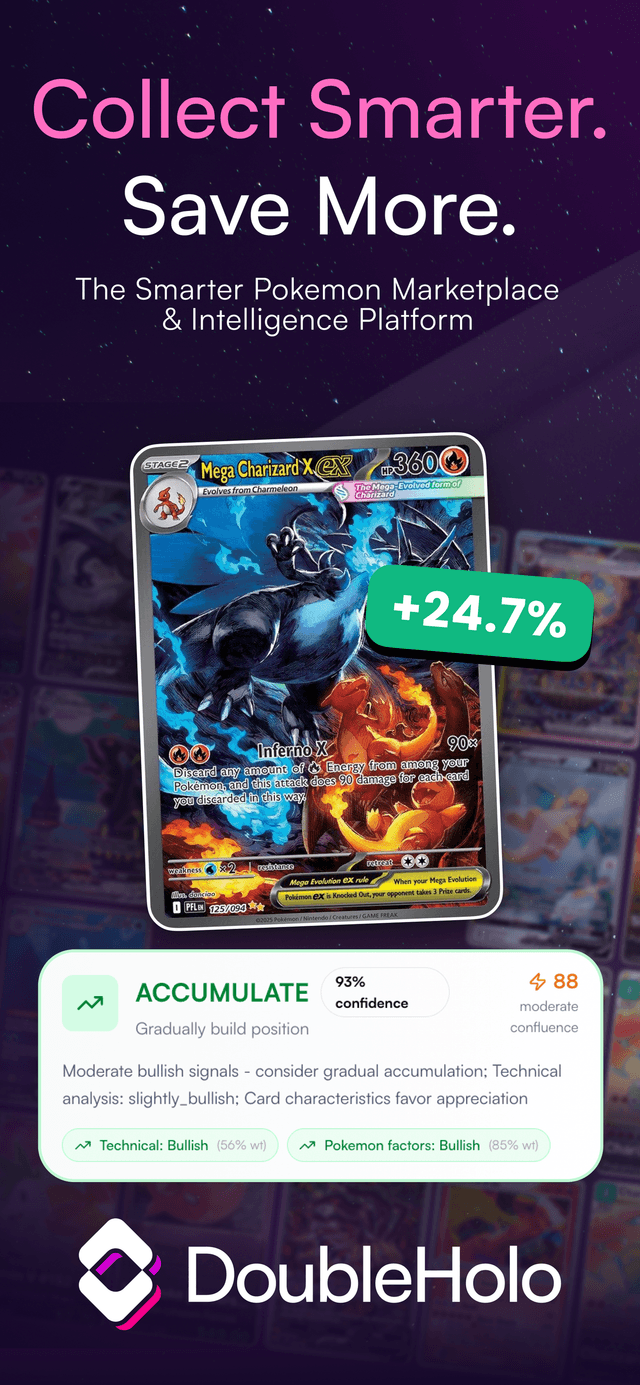
Manual price research works, but it doesn't scale. Double Holo's vendor intelligence suite uses machine learning to analyze market sentiment, forecast price movements, and surface AI-generated picks—cards likely to appreciate based on historical patterns and current demand signals. It's the difference between reacting to the market and anticipating it.
Try Double Holo Premium
Curated picks, grading ROI & data tools
Learn More →5. Photography and Listing Optimization
In online selling, your photos ARE your product. Buyers can't hold the card, so they rely entirely on images to assess condition and authenticity. Professional photography isn't a nice-to-have—it directly impacts conversion rates and prices.
Photo Setup Essentials
- Lighting: Natural daylight near a window, or a $30 LED ring light. Avoid harsh shadows and yellow incandescent light.
- Background: Plain white, black, or gray. A simple poster board works perfectly. Avoid busy backgrounds.
- Camera: Modern smartphone cameras are excellent. Use the main lens, not wide-angle. Clean the lens before shooting.
- Stability: Use a phone tripod or prop your phone against something stable. Shaky photos look amateur.
- Distance: Fill 70-80% of the frame with the card. Close enough to see detail, far enough to avoid distortion.
Required Shots for Every Listing
- 1.Full front - Clean, well-lit shot of the entire front of the card
- 2.Full back - Same quality, shows centering and back condition
- 3.All four corners (close-up) - Where wear shows first
- 4.Any flaws - Scratches, whitening, dents. Being upfront prevents returns.
- 5.For graded: slab front, back, and label close-up - Show cert number clearly
Title and Description Best Practices
Strong Title Example:
Charizard ex 199/165 Pokemon 151 SIR Special Illustration Rare NM
Includes: Pokemon name, card number, set name, rarity abbreviation, condition. Buyers search these terms.
Description Checklist
- • Card name, set, and number
- • Honest condition description with specific details
- • Any notable flaws explicitly mentioned
- • Shipping method and timeframe
- • Return policy (if applicable)
- • "Message with any questions" invitation
6. Inventory Management Best Practices
Once you're selling more than a handful of cards, inventory management becomes critical. Lost cards, overselling, and pricing errors eat into margins quickly. Systems save you.
Organization System
Physical Storage
Use labeled boxes or binders organized by set, then by card number. High-value cards ($50+) get individual toploaders in a separate secure location.
Digital Tracking
Spreadsheet minimum: Card name, set, condition, purchase price, purchase date, listing price, platform, listing date, SKU. Apps like TCGPlayer Pro or collectibles management software scale better.
SKU System
Assign every card a unique SKU. Format example: SET-NUMBER-CONDITION-DATE (151-199-NM-0108). Write the SKU on the toploader. This prevents duplicate listings and lost cards.
Multi-Platform Listing Management
Listing the same card on multiple platforms maximizes exposure but risks overselling. Solutions:
- • Manual sync: Check all platforms immediately after each sale and remove sold items. Works for low volume.
- • Software sync: Tools like Seller's Assistant or TCGPlayer Pro sync inventory across platforms automatically.
- • Primary platform strategy: List everything on one main platform, only cross-list high-value slow movers.
The Oversell Problem
Overselling damages your reputation and can get you suspended from platforms. If you sell the same card twice, immediately contact the second buyer, apologize, refund them, and offer a discount on their next purchase. Don't make excuses—own the mistake.
7. Customer Service That Builds Loyalty
In a market where buyers have endless options, customer service is your differentiator. Repeat customers don't need convincing—they already trust you. Building that trust starts with every interaction.
Response Time Standards
Handling Disputes Professionally
Disputes happen. How you handle them defines your reputation. The default approach: prioritize the relationship over being "right."
- 1.Listen first. Let the buyer explain fully before responding. Often they just want to feel heard.
- 2.Acknowledge their concern. "I understand why that would be frustrating" goes a long way.
- 3.Offer solutions, not excuses. Partial refund, full refund, exchange—give options.
- 4.Execute quickly. Once agreed, process the resolution immediately.
The Math on Refunds
A $20 refund that prevents a negative review is almost always worth it. One negative review can cost you dozens of future sales. Protect your rating fiercely—it's your most valuable asset.
8. Choosing the Right Selling Platforms
Platform choice impacts fees, buyer reach, and operational complexity. Most successful vendors use multiple platforms strategically, not randomly.
| Platform | Fees | Best For | Considerations |
|---|---|---|---|
| Double Holo | 4.9% platform + processing | Graded cards, high-value singles | Specialized Pokemon audience, vendor BI tools (AI picks, price forecasting) |
| TCGPlayer | 10.25%+ | Raw singles volume | Serious TCG buyers, competitive pricing required |
| eBay | 13%+ | Rare/vintage cards, auctions | Largest audience, higher dispute rate |
| Facebook Groups | 0% | Building personal brand | No buyer protection, requires reputation building |
| Local Shows | Table fee | Bulk clearing, networking | Time investment, cash handling |
Platform Strategy Recommendations
New Vendors (under $1K/month)
Start with one platform to learn the ropes. Double Holo is ideal—the 4.9% seller platform fee keeps more margin in your pocket compared to 10-13% on other platforms, and the vendor intelligence tools help you make data-driven decisions from day one. TCGPlayer works for raw singles volume; eBay if you have rare vintage pieces.
Growing Vendors ($1K-10K/month)
Add a second platform. List high-value cards on Double Holo (lower fees, serious collectors) and cross-list commodity cards on your highest-volume platform. Use price forecasting to time your listings strategically.
Established Vendors ($10K+/month)
Full multi-channel strategy with Double Holo as your primary for graded and premium cards. Leverage the AI picks and market sentiment tools to stay ahead of trends. Consider your own website for direct sales to your most loyal customers.
9. Shipping Like a Professional
Shipping is where many vendors lose money and reputation. A card that arrives damaged costs you a refund plus negative feedback. Invest in proper materials and processes.
Shipping Tiers by Value
Under $20: Plain White Envelope (PWE)
Penny sleeve → toploader → team bag → cardboard sandwich → stamped envelope. Cost: ~$1.50
$20-100: Bubble Mailer with Tracking
Same card protection, bubble mailer, USPS First Class with tracking. Cost: ~$4-5
$100-500: Padded + Signature
Add cardboard reinforcement, signature confirmation. Consider small box over mailer. Cost: ~$7-10
$500+: Priority Mail Insured
Priority Mail box, full declared value insurance, signature required, adult signature for $1K+. Cost: ~$15-25
Speed Expectations
- • Same-day handling for orders before 2pm local time
- • Next business day for orders after 2pm
- • Tracking uploaded within 24 hours of drop-off
- • Communicate delays proactively—buyers appreciate the heads up
Shipping Supplies Tip
Buy supplies in bulk. 1,000 penny sleeves costs less than 100 from a retail store. Same with toploaders, team bags, and bubble mailers. Amazon, eBay, and ULine have good bulk pricing.
10. Scaling Your Card Business
There's a ceiling to what you can accomplish solo. Scaling requires systems, delegation, and often, capital investment. Here's how vendors grow from hobby to business.
Stage 1: Systematize ($0-5K/month)
- • Document every process (listing, shipping, customer service)
- • Create templates for common communications
- • Set up proper inventory tracking
- • Establish consistent daily/weekly routines
Stage 2: Automate ($5K-20K/month)
- • Inventory management software with multi-platform sync
- • Data-driven pricing tools—Double Holo's price forecasting helps you set optimal prices based on market trends, not gut feelings
- • Label printing automation (thermal printer, shipping software)
- • Market intelligence tools to identify sourcing opportunities before competitors
Stage 3: Delegate ($20K+/month)
- • Hire part-time help for shipping and customer service
- • Train others on your documented processes
- • Focus your time on high-value activities (sourcing, pricing strategy, relationships)
- • Consider physical retail space if economics make sense
The Time-Value Calculation
Calculate your effective hourly rate. If you're making $50/hour on sourcing but spending time on $15/hour shipping tasks, hiring help for shipping is an obvious win. Work on your business, not just in it.
11. Common Vendor Mistakes to Avoid
Ignoring Fees in Pricing
Platform fees, shipping costs, payment processing, and supplies add up to 20-30% of sale price. Price accordingly or watch your margins evaporate.
Overpaying for Inventory
FOMO buying at inflated prices kills businesses. Have target buy prices and stick to them. Use price forecasting tools to know where the market is heading before you commit capital.
Neglecting Taxes
Card sales are taxable income. Set aside 25-30% of profits for taxes. Keep records of all purchases (cost basis matters). Consider consulting an accountant.
Poor Cash Flow Management
Tying up all capital in slow-moving inventory leaves you unable to buy when great deals appear. Keep a cash reserve for opportunities.
Inconsistent Grading Standards
Your "Near Mint" should match market expectations. Grade conservatively—underpromise and overdeliver beats the alternative.
Flying Blind Without Data
Relying on gut feeling in a data-rich market is leaving money on the table. Market sentiment shifts, price trends emerge, and grading ROI varies by card. Vendors using intelligence tools consistently outperform those who don't.
Burning Out
This should be enjoyable. If you hate listing cards at 11pm, something needs to change. Build sustainable systems, take breaks, remember why you started.
Frequently Asked Questions
How much money do I need to start selling Pokemon cards?
You can start with cards you already own and zero additional capital. To build inventory, $500-1,000 is enough to source a meaningful starting inventory through local collection buyouts or targeted online purchases. Reinvest profits to grow.
What's a realistic profit margin for Pokemon card vendors?
After all costs (purchase price, platform fees, shipping, supplies, your time), expect 15-30% net margin on most cards. Higher margins are possible on collection buyouts and underpriced finds. Volume vendors often accept lower margins for faster turnover.
Should I get a business license to sell Pokemon cards?
If you're selling regularly and generating meaningful income, yes. An LLC provides liability protection, and a business bank account separates personal and business finances. Sales tax requirements vary by state—many require collection over certain thresholds. Consult a local accountant.
How do I handle returns and refunds?
Have a clear return policy stated in listings. Standard practice: accept returns within 14-30 days for items not as described. Buyer pays return shipping for remorse returns. Process refunds quickly once you receive the card back in original condition.
Which cards are most profitable to sell?
In terms of margin, collection buyouts of vintage cards typically offer the best returns. For volume, modern chase cards from popular sets (currently Prismatic Evolutions, 151, Evolving Skies) move quickly. Graded PSA 10s of popular Pokemon command premium prices.
How do I compete with larger vendors?
Don't compete on price for commodity cards—you'll lose. Instead, focus on customer service, niche expertise (specific sets or eras), local relationships, and building a personal brand. Buyers pay premiums for vendors they trust.
What's the best platform for new Pokemon card vendors?
Start with one platform to learn the ropes. Double Holo offers a low 4.9% seller platform fee, a focused Pokemon collector audience, and vendor intelligence tools (AI picks, price forecasting, market sentiment, grading ROI) that help you make smarter decisions from day one. TCGPlayer works well for raw singles volume. Choose based on your inventory type and whether you value data-driven insights.
Start Building Your Pokemon Card Business
Success as a Pokemon card vendor isn't about luck—it's about systems, knowledge, and consistent execution. The vendors who thrive treat this like a real business while still enjoying the hobby that brought them here.
Start with what you have. Build processes that scale. Protect your reputation fiercely. The Pokemon TCG market rewards vendors who bring genuine expertise and professionalism.
Ready to start selling? Create your free Double Holo seller account and list your first card in minutes. With just a 4.9% seller platform fee and vendor intelligence tools like AI-powered picks, price forecasting, and grading ROI calculators, it's built for vendors who want to sell smarter and keep more of what they earn.
Ready to sell smarter?
Join thousands of Pokemon card vendors on Double Holo. A low 4.9% seller platform fee plus built-in business intelligence tools to help you price, source, and grow.